
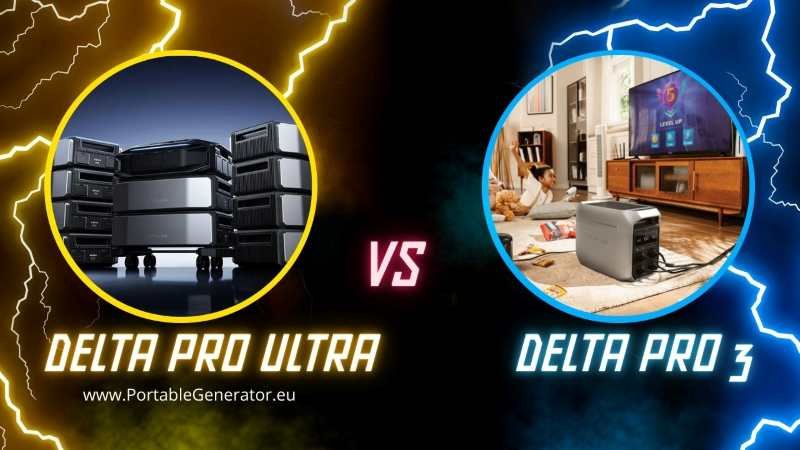
Delta Pro 3 VS DELTA Pro Ultra: The Definitive Guide to Choosing EcoFlow’s Best
If you’re looking to keep your lights on when the grid goes down, you’ve probably heard of EcoFlow. But navigating their lineup—especially the high-end Delta Pro 3 and the DELTA Pro Ultra—can feel overwhelming. Is the Ultra just a bigger version, or is it a completely different beast? Can a portable unit really power your entire house? We’re cutting through the confusion to help you decide which powerhouse is the right investment for your home and peace of mind.
Delta Pro 3 VS DELTA Pro Ultra – Let’s get right to the heart of the matter: choosing between these two is less about picking a “better” product and more about identifying the right tool for the job. One is a supremely capable portable powerhouse; the other is a scalable home energy system in a box.
Core Concept: Portable Power Station vs. Whole-Home Energy System
The most crucial distinction to grasp is the fundamental design philosophy behind each unit:
- Delta Pro 3: Think of it as the ultimate portable power station. It’s a single, heavy-duty unit (about 115 lbs) you can move with wheels and a handle, designed to power a suite of essential appliances, either by plugging them directly in or via a transfer switch.
- DELTA Pro Ultra: This is a modular home energy system. It consists of a separate inverter unit and stackable battery modules (the battery alone weighs ~111 lbs). It’s designed for semi-permanent installation, often integrated with your home’s main electrical panel to provide automatic, whole-house backup.

Head-to-Head: Delta Pro 3 vs DELTA Pro Ultra
Here’s a quick snapshot of how these two giants stack up on paper:
| Feature | EcoFlow Delta Pro 3 | EcoFlow DELTA Pro Ultra | What This Means for You |
|---|---|---|---|
| Starting Capacity | 4 kWh | 6 kWh | The Ultra offers 50% more power right out of the gate for longer essential runtime. |
| Max Expandable Capacity | 12 kWh | 90 kWh (with 3 inverters) | The Ultra’s scalability is in a different league, capable of growing with your needs. |
| AC Output (Continuous) | 4,000W | 7,200W per inverter (scalable to 21.6kW) | The Ultra can effortlessly start and run large central air conditioners (3-4 tons) and multiple heavy appliances simultaneously. |
| Voltage | 120V & 240V (native) | 120V & 240V (native) | Both can power 240V home essentials like dryers, well pumps, and ovens without extra accessories. |
| Solar Input | 2,600W Max | 5,600W Max per inverter (scalable to 16.8kW) | The Ultra can recharge much faster from solar, potentially harvesting a full day’s home energy in about an hour of good sun. |
| Best For | RV life, serious camping, essential home backup for small-to-medium homes. | Whole-house backup for medium-to-large homes, indefinite off-grid capability, and integration with rooftop solar. | |
| Form Factor | Single portable unit. | Modular system (separate inverter + stackable batteries). | The DP3 is movable; the Ultra is designed to be set up and expanded in place. |


What Makes the DELTA Pro Ultra Truly Unique?
So, the Ultra has bigger numbers. But its uniqueness goes far beyond specs.
- The Smart Home Panel 2 Integration: This is the game-changer. The Ultra is designed to work seamlessly with EcoFlow’s Smart Home Panel 2. This device connects to your main breaker panel and provides 20ms automatic switchover during an outage. You don’t lift a finger. More importantly, it lets you prioritize up to 12 critical home circuits (e.g., fridge, furnace, basement sump pump) from your phone, intelligently managing energy to extend backup time.
- Unmatched Scalability: You don’t need to buy it all at once. Start with one inverter and one 6kWh battery. As your needs or budget grow, you can add up to two more inverters and a total of 15 batteries for a staggering 90kWh of storage. That’s enough to power many average homes for over a month on essential loads.
- Industrial-Grade Charging Flexibility: Need power fast? The Ultra can accept a 5.6kW solar array per inverter and charge at a blistering 7,200W from an EV charging station using an adapter. It can also integrate with a gas generator for indefinite backup during long, dark storms.
| Model | Capacity | Expandable? | Peak Output | Best For | Details |
|---|---|---|---|---|---|
| EcoFlow DELTA Pro Ultra | Up to 90 kWh | ✅ Yes (15 Batteries) | 7.2 kW+ | Whole-home backup & solar + grid | View Product |
| EcoFlow DELTA Pro 3 + Batteries | Up to 12 kWh | Limited | 5 kW | Partial home backup | View Product |
| Generac Guardian 22kW Standby Generator | N/A (Fuel-powered) | N/A | 22,000 W | Whole-home backup with fuel | View Product |
| Tesla Powerwall + Backup Gateway | 13.5 kWh per unit | Stackable | 5 kW | Solar + backup | View Product |
✅ Notes:
- DELTA Pro Ultra gives clean, quiet energy with zero fuel.
- Standby generators work in extended outages but cost more to run.
- Powerwall thrives with solar ecosystems.

How Does the DELTA Pro Ultra Compare to Others?
When placed against its siblings and competitors, the Ultra’s position is clear:
- Vs. Original Delta Pro: The original Pro is a legendary workhorse, but is limited to 120V unless two are paired with a special cable. The Ultra offers more power, native 240V, and a modern, modular design.
- Vs. Jackery & Anker: Brands like Jackery and Anker SOLIX excel at portability and value for outdoor use. The Ultra is in a different category—it’s not competing on portability but on whole-home power and integration. It’s for when your needs outgrow a portable power station.
- Vs. Bluetti: Bluetti is known for exceptional battery lifespan (up to 6,000 cycles on some models) and is a strong choice for dedicated off-grid living. EcoFlow, particularly the Ultra, fights back with superior smart integration, faster charging speeds, and a more polished whole-home ecosystem via the Smart Home Panel.
| Model | Capacity | Solar Input | Output Power | Best For | Details |
|---|---|---|---|---|---|
| EcoFlow DELTA Max | 2 kWh | ⚡ Up to 800W | 2,400W | Mid-range power | 🔋 View Product |
| EcoFlow RIVER 2 Pro | 1 kWh | ⚡ Moderate | 1,800W | Travel & camping | 🔋 View Product |
| Bluetti AC200MAX | 2 kWh | ⚡ 900W | 2,200W | Heavy camping | 🔋 View Product |
| Jackery Explorer 2000 Pro | 2 kWh | ⚡ 1,200W | 2,200W | Outdoor power | 🔋 View Product |
👉 Get DELTA Pro 3 Special Offers Today
Key Considerations: Your Questions Answered
1. Is the DELTA Pro Ultra Expandable?
Absolutely, that’s its core strength. Its modular “building block” design is built for expansion. You can grow capacity from 6kWh to 90kWh and output from 7.2kW to 21.6kW by adding more battery and inverter modules.
2. What is the Lifespan of a DELTA Pro Ultra?
The heart of the system is its Lithium Iron Phosphate (LFP) battery. EcoFlow rates it for 3,500 cycles to 80% of its original capacity. What does this mean in practice?
- Daily Use: If you used and recharged it every single day, that’s nearly 10 years of service.
- Backup Use: If you only use it for occasional outages and seasonal storms, the physical lifespan could easily extend 15+ years.
This lifespan is a significant advantage over older battery technologies and even many standard lithium-ion packs.


3. How Many Solar Panels to Charge It & How Long Will 13.5 kWh Last?
- Solar Charging: A single Ultra inverter can handle up to 5.6kW of solar input. Using EcoFlow’s 400W rigid panels, that’s about 14 panels. With three inverters, you can connect up to 42 panels for 16.8kW of input.
- Runtime Example: Let’s take a 13.5kWh battery setup (a realistic expansion). Here’s a rough estimate of what that could power:
- Refrigerator (300W) + Lights (100W) + WiFi (10W): Could run for over 33 hours.
- Central A/C (3.6kW): Could run for about 3.75 hours.
- A mix of essentials (fridge, lights, fan, TV, modem): Could easily last 24-48 hours or more, depending on use.
4. How Long Does EcoFlow DELTA Pro Ultra Last?
That depends on your load.
| Appliance | Estimated Runtime |
|---|---|
| Refrigerator | 3–4 days |
| Wi-Fi + devices | 5–6 days |
| HVAC (intermittent) | 12–18 hours |
| Whole home (light use) | 1–2 days |
5. Can It Power a Whole House? Is 7.2kW Enough?
This is the million-dollar question.
- With Smart Management, Yes: A single 7.2kW Ultra inverter can power the critical circuits of most houses. Using the Smart Home Panel 2 to prioritize essentials and avoid running an air conditioner, dryer, and oven all at once, it can keep your home functional.
- For Full, Unrestricted Power: To truly mimic grid power and run anything at any time in a larger home, you’d likely need the expanded 21.6kW output from three inverters. An electrician can help you calculate your home’s specific “starting surge” and continuous load needs.
The Ultimate Question: Is the EcoFlow DELTA Pro Ultra Worth It?
The Delta Pro 3 starts around $2,299, while the DELTA Pro Ultra inverter and one battery start around $4,099.
The Delta Pro 3 is worth it if: You need powerful, portable backup for an RV, a critical room in your house, or a small-to-medium home via a transfer switch. It’s a fantastic, all-in-one solution.
The DELTA Pro Ultra is worth it if:
- You want automatic, whole-home backup without thinking about it.
- You have a medium to large home with higher energy demands.
- You plan to integrate with solar now or in the future.
- You want a system that can scale exponentially as your needs change.
- You value smart energy management to potentially reduce bills (using stored solar during peak rate times).
For qualifying U.S. homeowners, the 30% federal solar tax credit can also be applied to the Ultra and its installation, significantly improving its value proposition.
Conclusion: Making Your Choice
Choosing between the Delta Pro 3 and the DELTA Pro Ultra boils down to your definition of “backup power.”
- Choose the Delta Pro 3 for portable, potent, and versatile power. It’s the Swiss Army knife on steroids—perfect for life on the go or securing the essentials at home with a simpler setup.
- Choose the DELTA Pro Ultra for true energy independence and resilience. It’s not just a product; it’s a future-proof home energy platform. It’s the choice for those who never want to worry about an outage again and see their backup system as a long-term investment in their home’s infrastructure.
Both are exceptional tools from a leading brand. By understanding the fundamental difference between a portable power station and a modular home energy system, you can invest with confidence, knowing your lights—and your air conditioner—will stay on when you need them most.
EcoFlow Stores
 |  |  |
| Visit Store | Visit Store | Visit Store |
 |  |  |
| Visit Store | Visit Store | Visit Store |
 |  |  |
| Visit Store | Visit Store | Visit Store |
FAQs: Delta Pro 3 VS DELTA Pro Ultra
Can the Delta Pro Ultra work with my existing rooftop solar panels?
Yes, it can. When integrated with the EcoFlow Smart Home Panel 2, the DELTA Pro Ultra system is compatible with existing rooftop solar installations. It can use your solar panels to charge its batteries and power your home, even during a grid outage—a feature many traditional grid-tied solar systems lack.
What is the 40-80 rule for batteries, and does it apply to the DELTA Pro Ultra?
The 40-80 rule is a guideline for older lithium-ion batteries, suggesting you keep them charged between 40% and 80% to maximize lifespan. The DELTA Pro Ultra uses more advanced Lithium Iron Phosphate (LFP) chemistry, which is far more durable and less stressed by full charges. While avoiding constant 100% discharge is still good practice, the strict 40-80 rule is less critical for LFP batteries like the Ultra's.
How does the Delta 3 Ultra Plus fit into the comparison?
The Delta 3 Ultra Plus is a more affordable alternative to the Delta Pro 3, offering similar core backup functionality for about $800 less. Key compromises include a lower 3kWh capacity, 120V-only output (no native 240V), and less expandability. It's a great budget pick for essential backup in apartments or small homes, but for powering 240V appliances or larger-scale needs, the Delta Pro 3 or Ultra are better choices.
Is the DELTA Pro Ultra loud when operating?
No, it's extremely quiet. For household loads under 2000W, its fans can stay off, resulting in 0dB of noise—perfect for nighttime operation. Even under higher loads, its advanced X-Cooling system is much quieter than a gas generator, making it suitable for installation in a garage or utility room without disturbance.
Do I need an electrician to install the DELTA Pro Ultra?
Yes, for any setup involving the Smart Home Panel 2 and connection to your home's main electrical system, a licensed electrician is required and strongly recommended for safety and compliance. EcoFlow offers installation service packages in many areas. For simpler, plug-in applications (like powering individual appliances), you can set it up yourself.
Can EcoFlow DELTA Pro Ultra replace a gas generator?
Yes, for most homes—without noise, fuel, or emissions.
How long can DELTA Pro Ultra power a fridge?
Anywhere from 3 days to over a week, depending on battery size.
Is EcoFlow DELTA Pro Ultra safe indoors?
Yes. It’s silent, fume-free, and LFP-based.
Can I expand DELTA Pro Ultra later?
Absolutely. That’s one of its biggest strengths.
Does EcoFlow Ultra work with solar only?
No—it supports solar, grid, generator, or hybrid charging.
You Might Also Like


