
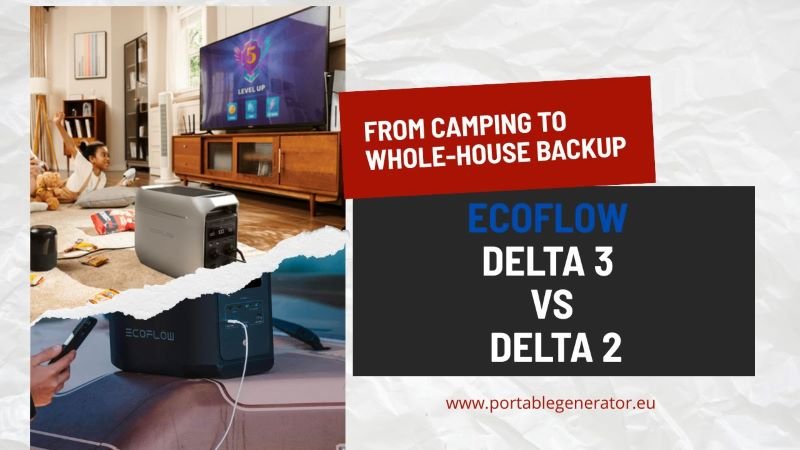
EcoFlow Delta 3 vs Delta 2: Your Complete Guide to Portable Power from Camping to Whole-House Backup
EcoFlow Delta 3 vs Delta 2 – Ever found yourself staring at a collection of letters and numbers—Delta 2, Delta 3, Delta Pro 3—and wondering what it all means for your next camping trip or your home’s emergency preparedness? You’re not alone. The world of portable power stations has exploded, and EcoFlow’s Delta series sits right at the forefront.
But with great choice comes great confusion. Is the Delta 3 Max a real thing? Can one of these boxes really keep your fridge running during a blackout? And what’s the deal with battery lifespan?
Think of this guide as your friendly power-savvy neighbour, here to cut through the jargon. We’re going to unpack everything, from the simple question of which model exists to the big one: can it truly power your whole house? Let’s plug in and get started.

Decoding the Delta Lineup – What Exists and What It Does
First things first, let’s clear up the model mystery. EcoFlow’s naming can feel like alphabet soup, but there’s a clear logic once you see the whole picture.


1. Is There an EcoFlow Delta 3 or Delta 3 Max? Setting the Record Straight
Yes, there is an EcoFlow Delta 3. It’s the modern successor to the popular Delta 2, featuring a 1024Wh (watt-hour) base capacity and a 1800W (watt) continuous AC output. It’s designed as a versatile, all-rounder power station.
Now, about the “Max” label. Currently, EcoFlow offers the Delta 3 Max and the more powerful Delta 3 Max Plus. Both share a 2048Wh base capacity but differ in their output: the Delta 3 Max delivers 2400W, while the Delta 3 Max Plus kicks it up to a robust 3000W. So, to answer your question directly: the Delta 3 Max is not just a concept—it’s a real, powerful product you can buy.
2. The Heart of the Matter: Delta 2 vs. Delta 3 – Which Should You Choose?
This is the core comparison for many buyers. The Delta 2 is a proven, excellent value. The Delta 3 is its refined, more advanced sibling. Your choice depends on your priorities. Let’s break it down:
- Battery Longevity & Tech: This is the biggest upgrade. The Delta 3 series uses LiFePO4 (LFP) batteries rated for 4,000 charge cycles before dropping to 80% capacity, compared to 3,000 cycles for the Delta 2 series. This translates to a significantly longer potential lifespan—think a decade of reliable use.
- Performance & Features: The standard Delta 3 (1024Wh) matches the Delta 2’s 1800W output. However, the Delta 3 has a faster 10ms Uninterruptible Power Supply (UPS) switchover, crucial for protecting sensitive electronics like computers and NAS devices during a power flicker. The Delta 3 Max models, with their 2400W and 3000W outputs, outpower the Delta 2 Max.
- Expandability: Here’s a key point: Yes, the Delta 3 Max is expandable. You can connect it to extra batteries to scale its capacity from 2kWh up to 10kWh. The standard Delta 3 is also expandable up to 5kWh.
Here’s a quick visual guide to the key differences:
| Feature | EcoFlow Delta 2 (1024Wh) | EcoFlow Delta 3 (1024Wh) | EcoFlow Delta 3 Max (2048Wh) |
|---|---|---|---|
| Base Capacity | 1024Wh | 1024Wh | 2048Wh |
| AC Output (Continuous) | 1800W | 1800W | 2400W |
| Battery Chemistry & Life | LFP, 3000 cycles to 80% | LFP, 4000 cycles to 80% | LFP, 4000 cycles to 80% |
| UPS Switchover Time | <30ms | <10ms | <10ms |
| Max Expandable Capacity | Up to 3kWh | Up to 5kWh | Up to 10kWh |
| Best For | Excellent value for entry-level backup, camping, DIY. | Future-proof choice for tech, longer lifespan, faster UPS. | High-power needs for tools, longer runtimes for home backup. |
So, is the Delta 2 still worth it? Absolutely, if your budget is tight and your immediate power needs are modest. It’s a fantastic workhorse. But if you want the latest battery tech for longevity, faster protection for gadgets, and more headroom for expansion, the Delta 3 is the better, more future-proof investment.


3. What About the Delta Pro 3? Entering Whole-House Territory
When the questions shift from “can it run a fridge?” to “can it run my house?”, you’ve entered Delta Pro 3 territory. This is a different class of device. With a massive 4096Wh base capacity, a 4000W output (surge to 8000W), and the ability to expand to a staggering 48kWh, the Delta Pro 3 is engineered as a modular home backup solution.
It can connect to a Smart Home Panel to power selected circuits in your house and can even support 240V appliances like well pumps or dryers.
Power in Practice – From a Single Appliance to Your Entire Home
Let’s move from specs to real-world scenarios. What can these boxes actually do?
1. Can a Delta 3 Power My Whole House?
This is the million-dollar question, with a nuanced answer. The standard Delta 3 (1024Wh, 1800W) is not designed to power a whole house. It’s perfect for powering essentials: keeping your fridge cold, your wifi and phones running, a few lights on, and maybe a laptop for hours. It’s your outage life raft.
True whole-house backup—running air conditioners, electric stoves, and water heaters simultaneously—requires a permanent, high-capacity system like the Delta Pro 3 integrated with a Smart Home Panel. This setup allows you to select critical home circuits to back up.
2. How Long Can an EcoFlow Power a House? The Runtime Equation
Runtime isn’t a single number; it’s a calculation. It depends entirely on what you’re powering and the capacity of your unit.
Let’s use the Delta 3 Max (2048Wh) as an example:
- A modern fridge (~200W): Could run for roughly 6-12 hours.
- A 50″ LED TV (~110W): Could run for about 0.3-0.5 hours.
- A phone charger (~10W): Could recharge phones dozens of times.
For a Delta Pro 3 setup, runtimes can extend to days for essential circuits, especially when expanded with extra batteries. The key is to add up the wattage of the appliances you want to run simultaneously and compare it to the unit’s output. Then, consider their energy consumption (watt-hours) against the unit’s capacity.
3. Wattage Decoded: How Many Watts is the Delta 3 Plus Max?
You asked about the “Delta 3 Plus Max.” Based on the product line, this likely refers to the Delta 3 Max Plus. This powerhouse has a 3000W continuous AC output with a 6000W surge capability. Surge power is that extra burst needed to start motor-driven appliances like fridges or power tools. With EcoFlow’s X-Boost mode, it can even support devices up to 3800W. This makes it capable of running heavy-duty tools, large kitchen appliances, or a broader array of home essentials at once.

Investing in Longevity – Maximising Your EcoFlow’s Lifespan
You’re investing in a durable power source. How do you make it last?
1. What is the Lifespan of an EcoFlow Delta 3?
This is where the Delta 3 series shines. Thanks to its LiFePO4 (LFP) battery chemistry, the Delta 3, Delta 3 Max, and Delta Pro 3 are all rated for 4,000 full charge cycles while retaining 80% of their original capacity. If you used and recharged it every single day, that cycle life translates to over 10 years of use. In more typical intermittent use (camping trips, occasional outages), it could last far longer.


2. The Golden Rules: How to Care for Your Power Station’s Battery
Longevity isn’t just about a number on a spec sheet; it’s about how you treat the unit. Follow these simple guidelines:
- Avoid the Extremes (The 40-80 Rule): While LFP batteries are robust, for optimal long-term health, try to keep them between 40% and 80% charge for daily use or storage. Avoid constantly draining to 0% or leaving it plugged in at 100% for weeks on end.
- Mind the Temperature: Don’t charge your power station in freezing temperatures (below 32°F/0°C) or in extreme heat. Store it in a cool, dry place.
- Use the App: The free EcoFlow app is your maintenance dashboard. Use it to monitor battery health, set charging limits, and keep the firmware updated.
3. Can EcoFlow Batteries Be Replaced?
Yes. A major advantage of the expandable Delta series is that the extra batteries are separate, replaceable modules. Furthermore, EcoFlow offers a 5-year warranty (3-year standard + 2-year extended with app registration) for the Delta 3 series, providing long-term peace of mind.
Conclusion: Finding Your Perfect Power Match
EcoFlow Delta 3 vs Delta 2 – Choosing the right EcoFlow Delta isn’t about finding the “best” one—it’s about finding the right one for you.
For portable adventures and core essentials backup, the Delta 3 is a stellar, future-proof choice with its long-life battery. If you need more power for tools or longer runtimes for a family during an outage, step up to the Delta 3 Max or Max Plus.
When your goal shifts to true, seamless home backup for multiple circuits and high-wattage appliances, the Delta Pro 3 ecosystem is the solution, designed to integrate into your home’s electrical system.
No matter which you choose, you’re investing in resilient, quiet, and versatile power. By understanding your needs and treating your unit with simple care, you’re not just buying a battery box—you’re buying peace of mind for the next decade of adventures and unexpected outages.
EcoFlow Stores
 |  |  |
| Visit Store | Visit Store | Visit Store |
 |  |  |
| Visit Store | Visit Store | Visit Store |
 |  |  |
| Visit Store | Visit Store | Visit Store |
FAQs About EcoFlow Delta 3 vs Delta 2
- I live in a small apartment and mainly want backup for my wifi, fridge, and phone during occasional outages. Which model is sufficient?
The standard EcoFlow Delta 3 (1024Wh) is perfectly suited for this. It can easily power those essentials for many hours and is more portable and affordable than the larger Max models. - Can I use an EcoFlow Delta to power a medical device like a CPAP machine overnight?
Yes, absolutely. All Delta models provide clean, stable sine wave AC power suitable for sensitive medical equipment. Calculate the CPAP’s wattage (check its label or manual) and ensure the unit you choose has sufficient capacity (watt-hours) to last the night. The Delta 3’s near-silent operation (<30dB) is also a major benefit for bedside use. - How do I “plug my EcoFlow into my house” to use it as a backup?
For basic use, you simply plug appliances directly into the unit’s outlets. For backing up hardwired appliances (like a furnace) or wall outlets, you need a transfer method. The simplest is a manual transfer switch installed by an electrician, which safely connects the Delta Pro 3 to selected home circuits. For full integration, the Smart Home Panel 2 works with the Delta Pro 3 for automatic, app-controlled backup. - Is it worth getting the solar charging option?
Solar charging transforms your power station from a finite battery to a renewable energy source. It’s invaluable for long camping trips, RV use, or preparing for multi-day outages where grid power isn’t available to recharge. Even for daily use, you can top up the unit with sunlight to reduce your electricity bill. - My old portable power station died quickly. How is EcoFlow’s battery management different?
EcoFlow units have a sophisticated Battery Management System (BMS) that acts like a brain for the battery. It monitors over 40 safety parameters—including voltage, current, and temperature—24/7 to prevent overcharging, deep discharging, and overheating. This active protection is key to achieving the long 4,000-cycle lifespan and ensuring safe operation.


